Maydena and Giant Eucalyds

image

image

image

imageFeb 5 & 6

The ride towards Maydena was a repeat of our original trip up from Hobart until the turn to Mt. Fields National Park and then on to Maydena, the last little village in this wilderness. As I traveled on the small road towards the park I came upon a field of what looked like hops. A few corners later then more. Then some really big fields. Now I started to wonder if I was confusing the tall vine like plants for something else. A stop in a small coffee shop confirmed that I was right. They told me that the climate here was just right and most of them went to Cascade Brewery, the largest producer in Tassie and located in Hobart.

I stopped at the Park Headquarters to take a look, but knew that a better adventure could probably be found in Maydena. Continuing on my way, I was soon peddling up a steep hill off of the far end of this tiny little logging town. Maydena Cabins and Alpacas. What the hell were alpacas doing here, I wondered. Derek, who along with his wife Anthea were the owners, told me that the animals were here when he bought the place ten years ago and that he had grown to enjoy them. So they grazed just in front of my nice little cabin. I also had a great view of the surrounding peaks. And talk about quiet.

I came here with the idea of seeing some of the tallest trees in the world. Unlike the Huon Pines we saw on our cruise up the Gordon River out of Strahan, some of which were over 3000 years old and grew only 1 ml in diameter a year, the Eucalyptus or Gum trees here grow into Giants. These Eucalyds keep their leaves year round. There is only one Native deciduous tree in Australia and I can’t remember its name (I am posting on the net here by standing up next to the owners house. Don’t want to stand there researching or they might think I’m lurking).

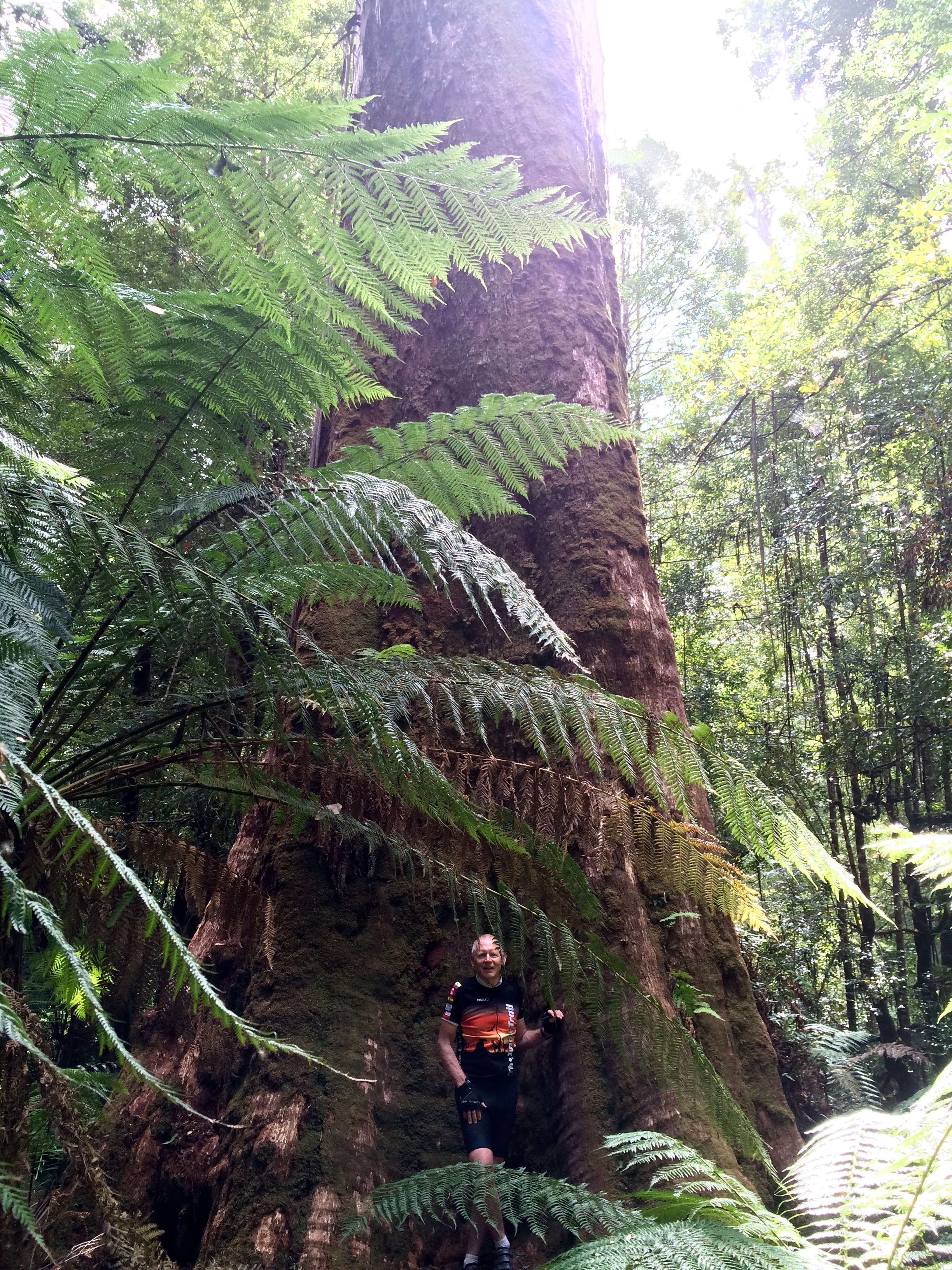
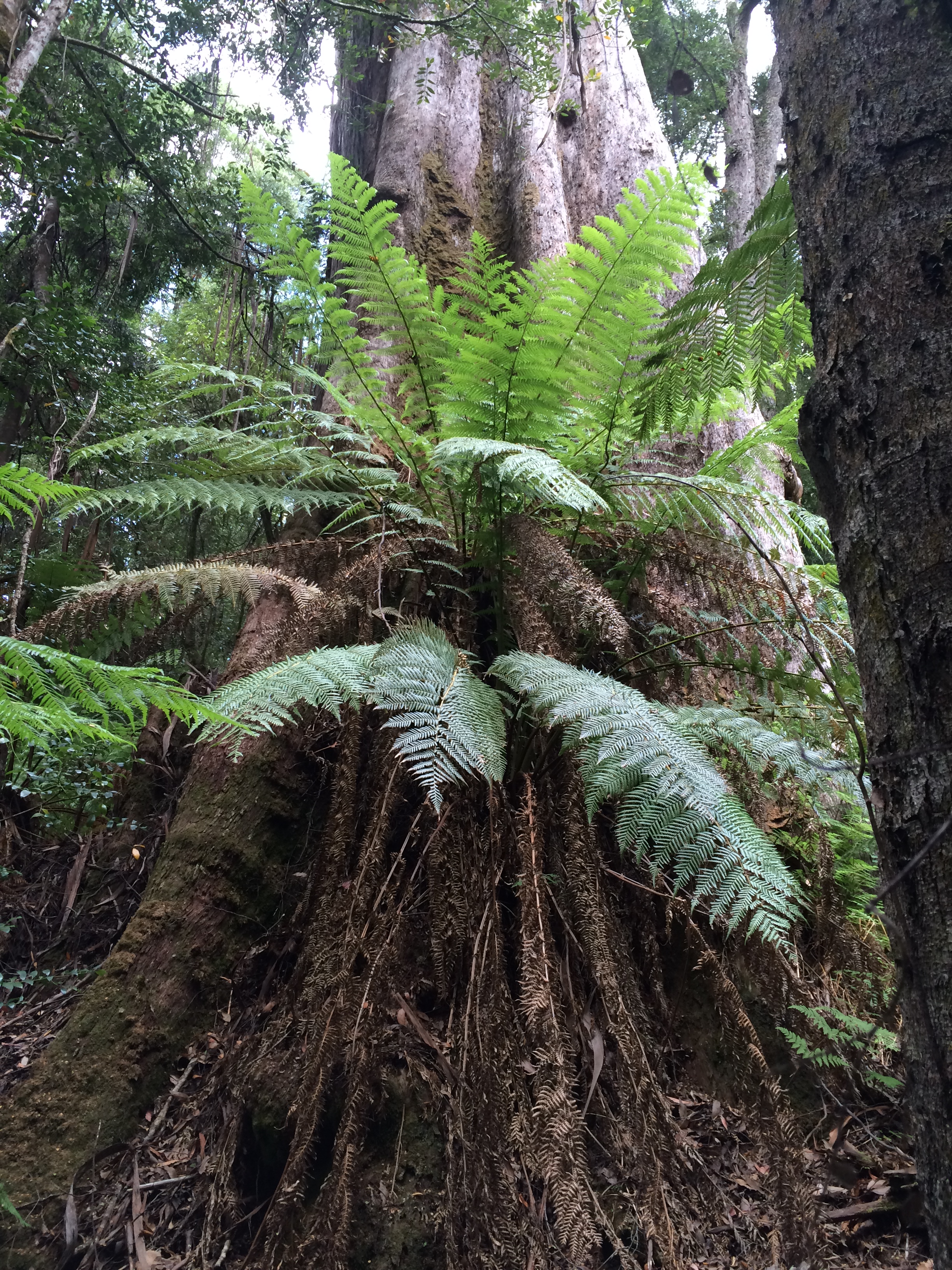
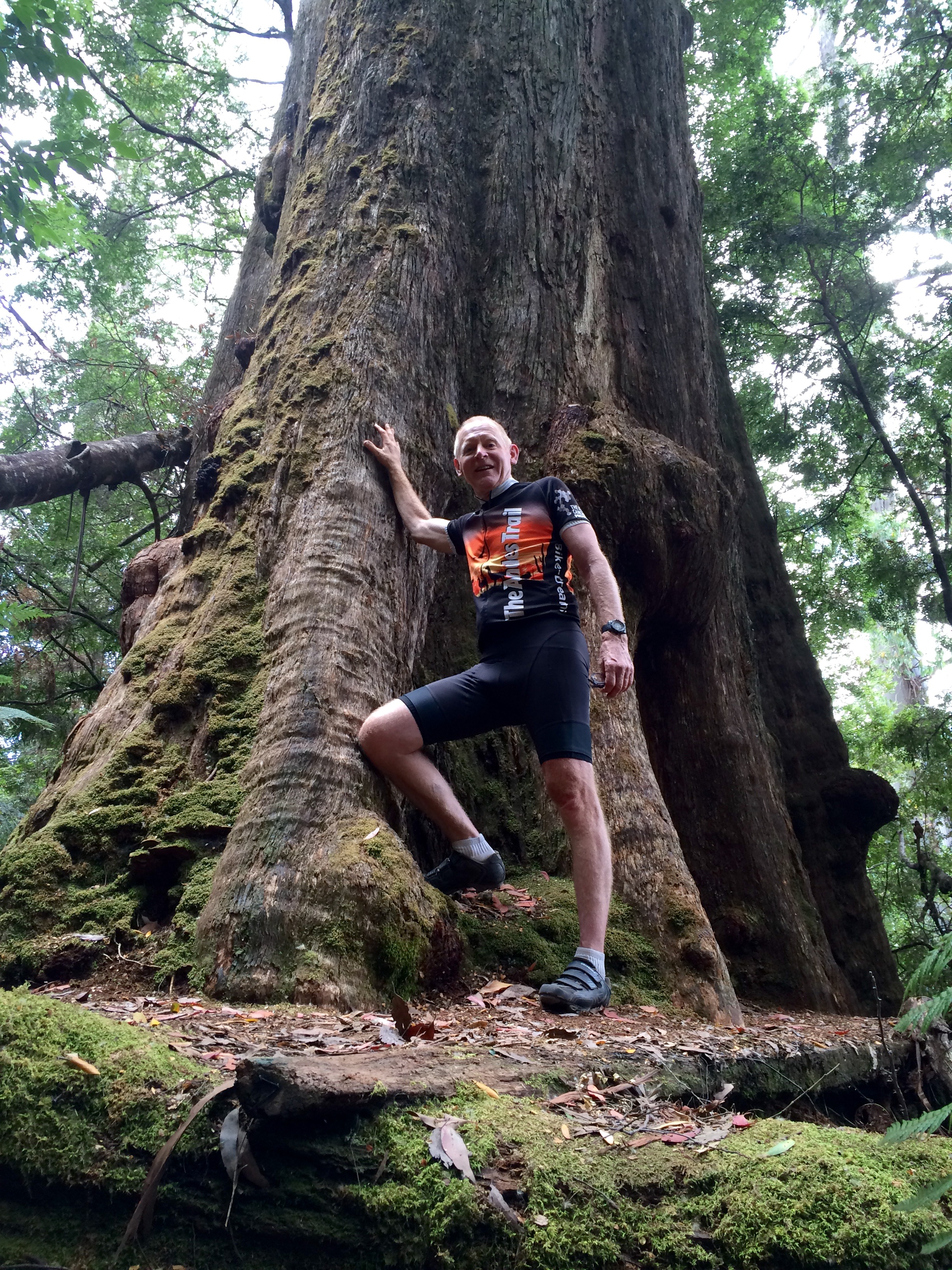
In the morning I hopped onto my bike and rode a few K’s down to a dirt logging road which took me into the Styx River area. I followed this gravel track for 15k till I came to a one car pullover and a trail with a sign saying Big Tree Reserve. Great, up the trail I hiked, keeping my eyes peeled for snakes. There are three basic varieties here and they are all venomous. I had seen a black one about 6 feet long slithering across the road earlier. They won’t attack you unless you step on them or something. I first came to huge tree with a small sign saying Big Tree. The base was huge. It was not round like a Giant Redwood, but very irregular with many different shapes jutting out. I took a few photos then headed up to the one called Bigger Tree. The sign here said 87 meters high. This base was even larger. I think the tallest tree in the US is 97 meters high but no research for me today so not sure. The sign also said that a few taller Gum Trees had been found nearby. I wished I could take a photo of me next to the big tree.

As I walked back out an older car came rumbling up to a stop. A lanky young blonde man came out and fished for his tripod and camera out of the back seat. I learned that he was British, was 23, and had been traveling for over two years. Everything he owned was in that back seat. He had bought the old car for three hundred fifty dollars and now had a few thousand K’s on it. Paid for it by picking cherries. George was the first person I had seen all day and just in time to take my photo back at the Big trees. After we got the photos, George told me that there were taller trees nearby up a side road called the Waterfall Creek Road. It had been the sight of a major protest with people camping in and around this group of tall trees when a logging firm had gotten within a half a K from them. Some had stayed in the trees for up to six months. The end result was a compromise – the huge trees were protected and the loggers were allowed to continue logging as long as they replanted in this World Heritage Site.

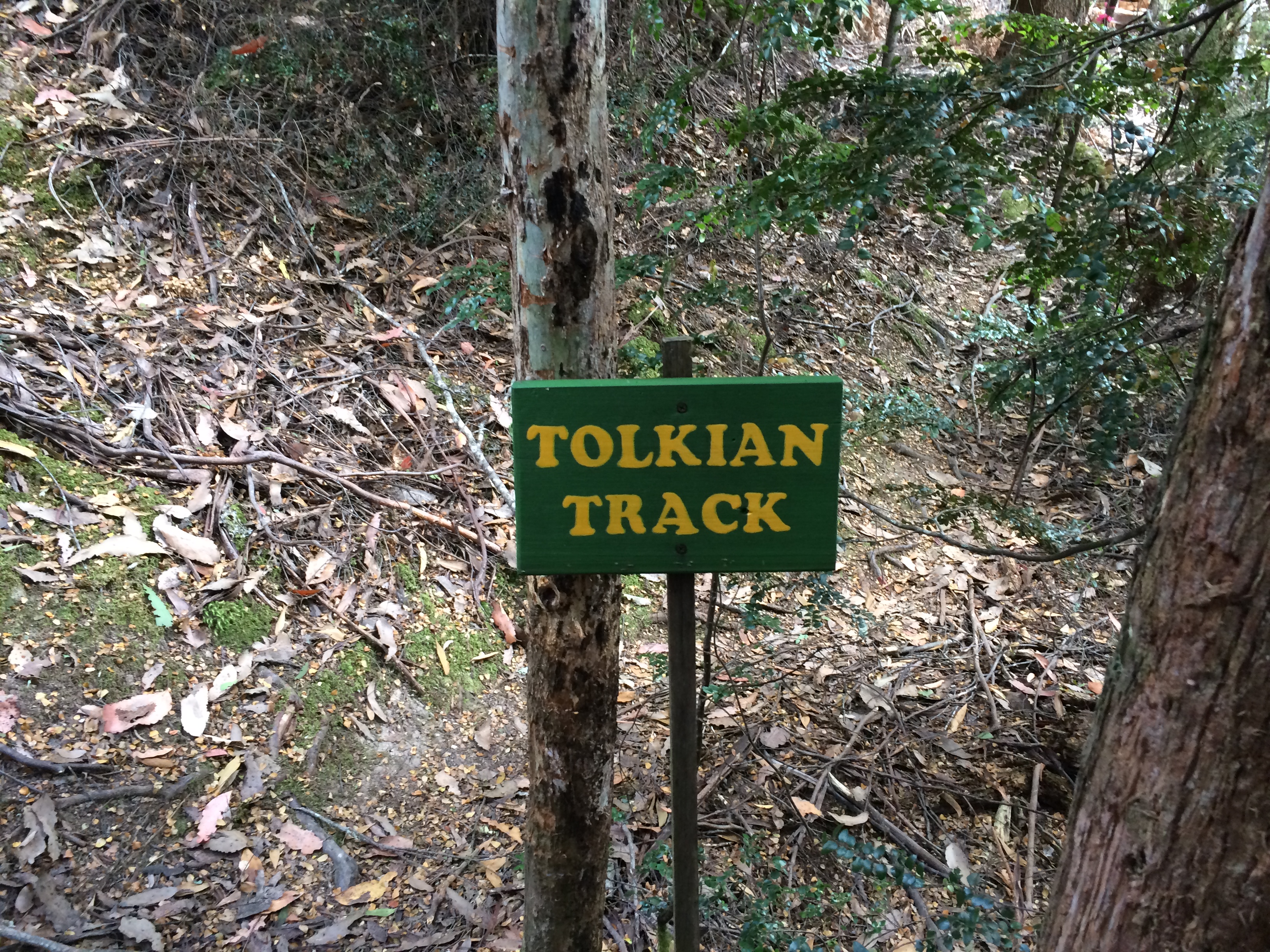
George worked on setting up his photos while I got back on the bike off looking for the right road. After about 6k with several side roads, none of which had a name, I started back. George met me in his car so I left my bike and hopped in the old buggy with him leaving my bike on the side of the road. After about 15K of driving and several more unnamed side roads, we gave up trying to find the Tolkien Track with Gandalf, Morannon, Fangorn and many other big behemoths. He dropped me off at my bike and took off. As I pedaled back I decided to try one more side road near our original stop at the Big Tree Reserve. As I crested the top of this steep roadway I spotted a vehicle parked on the side of the road and knew I had found it. The trail itself was marked only by an orange survey taped wrapped around a tree and was little more than a deer trail with occasional orange ribbons. There were a lot of really big gum trees throughout this little area including the largest, Gandalf’s Staff. These trees and the area had been named by the protestors who had spent weeks in tree platforms to save them from the logging operations slated to cut them down. It certainly was a forest track worthy of the Lord of the Rings. I got some photos and spent some time enjoying the magic of this place.

As I was getting on my bike to pedal home up roared George in the second hand rambler. Down went his window and I was met by a toothy grin. “George,” I said, “I’m so glad you found this place too.”

It was a great day worthy of a glass of wine which I enjoyed with George and Anthea in my little cabin.

Sent from my iPad
Hobart Again and Farewell to Barry

image

imageFeb 3 and 4

We woke up the sound of rain on the roof on White Beach knowing we had a long day ahead of us. Pam had offered to give us a ride to Hobart but Barry and I wanted to finish up the way we started – on our bikes. So we said our goodbyes to Pam and Rod and took off in a steady drizzle. About 5k up the road it started to really pour – since it was warm enough, I didn’t really care knowing it wouldn’t last. Looking back at one point, I saw that Barry wasn’t behind me so I pulled under a big tree to wait. It turned out that Barry pulled over at the little country store to say a quick goodbye. Before he got out of there here came Rod pulling up in his car. Pam and Rod were concerned about the big rain. They were so thoughtful and accommodating the whole visit – this was just one more example. Barry again said his goodbyes and soon was riding up to me. Half-way through our 105k trip the sun came out and Barry was happy again.

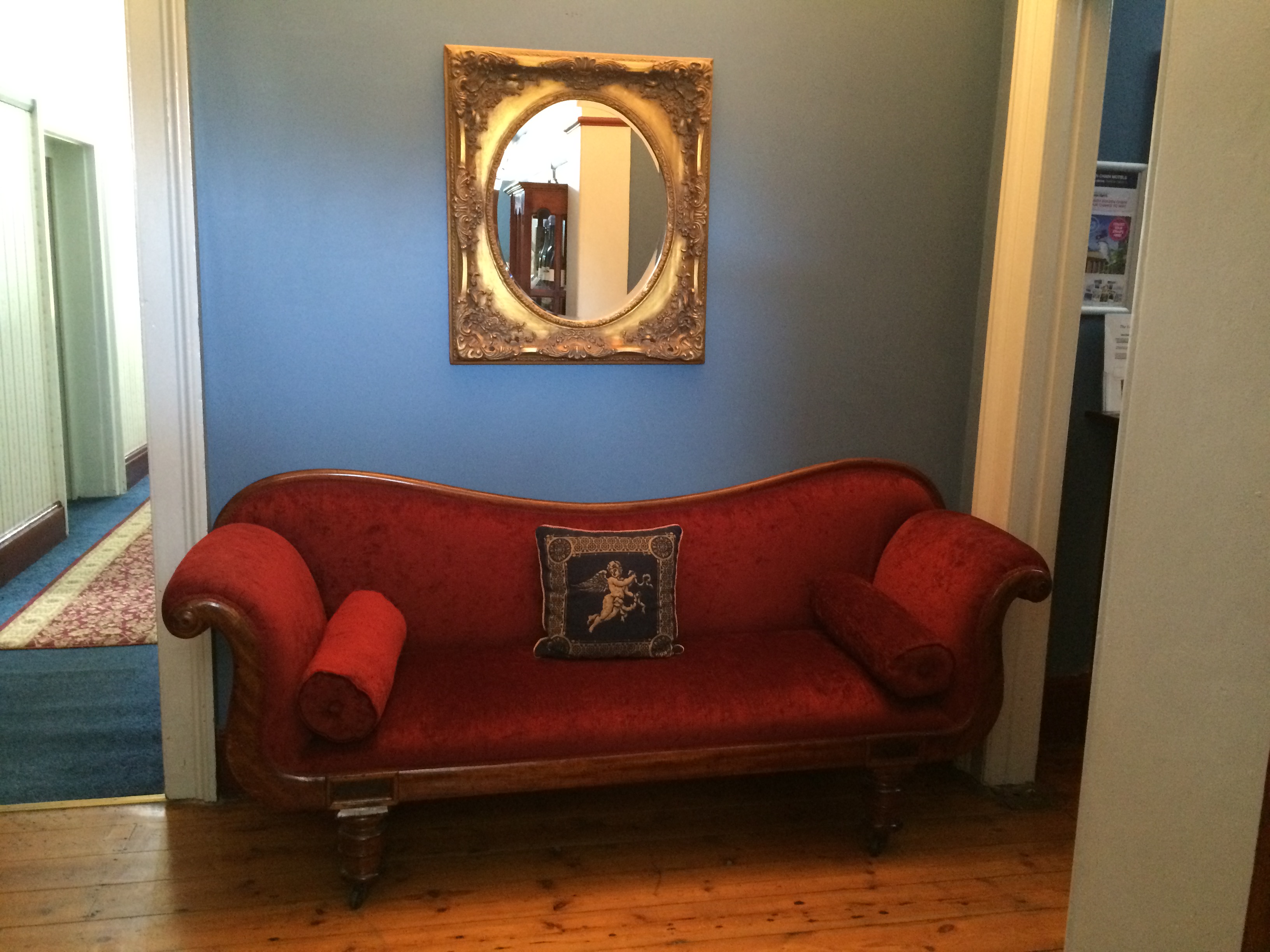
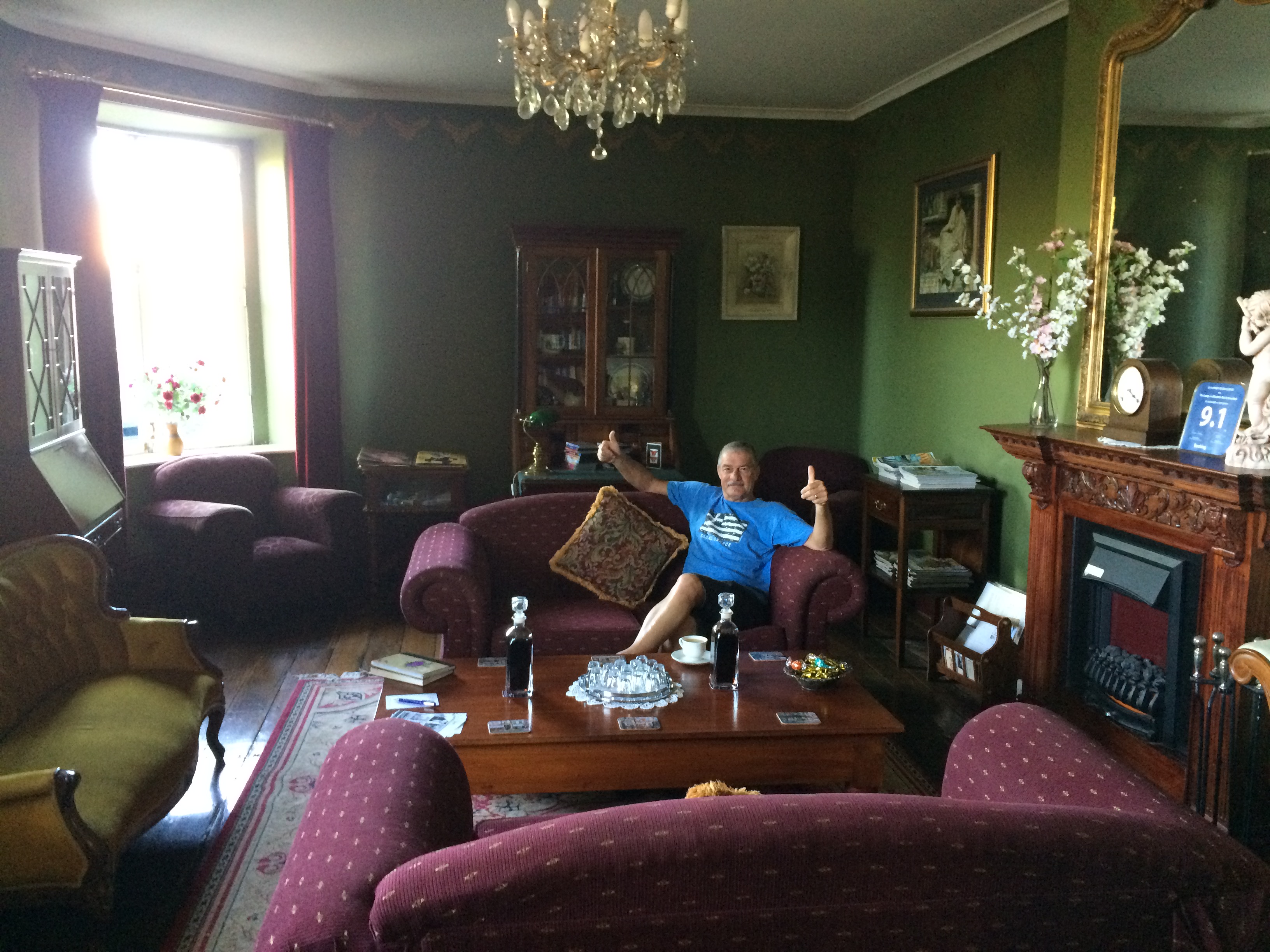
We biked up Elizabeth Street upon our arrival in Hobart, to the Lodge at Elizabeth. The owner, Jeff, has been great to us, letting us keep our bike boxes and my duffle in his garage as well as locking my laptop with passport and money in his safe the whole time we’ve been biking round Tassie. The Lodge was a private home when it was built in 1829. Since Hobart was first established in 1804 this has to be one of the oldest homes still around. It is lavish and beautiful still. There remains an original couch from the year the house was built. All of the furniture was from the same period. The Premier once lived here and now Jeff has 14 rooms that he rents out as his B&B. We loved our time here.

Barry and I got all of our various chores done the next day, then had a celebrating dinner for our successful trip that night. We chose an attractive Mexican place just up the street and while the food was very good, I paid for it most of the night. Not much sleep for this boy.

Barry and I said our goodbyes at the bus stop as we loaded his bike in the underbelly and he was off to the airport, on to Sydney, and then home to his wife Trish. We had a great time here – it seemed to end too soon like most adventures. I’m sure he will wake tomorrow expecting to be on his bike, then realize he was back home.

I set off back up the west side of Tassie but this time turned off towards the last little village on the way to the Gordon Lake Dam and some real wilderness. Maydena.

Sent from my iPad

Tasman Island

Feb 2

This morning Barry and I took his sister Pam’s car over to Port Arthur to get on a steel bottomed Zodiac type boat for a cruise down the coastline of the Tasman Peninsula and out to visit the lighthouse on Tasman Island. The boat had 36 seats, all but 6 were weather protected by by an overhead cover. There were about 10 unoccupied seats which made it nice to move around for different photos opportunities. We started out by motoring past the famous ruins of the Port Arthur Penal Colony. Tasmania was originally established as a place for England to house its convict population and well known for the cruelty and Inhumane treatment of these individuals.

Moving out of the harbor and down the coastline it didn’t take long to approach the first of the incredible rock formations that dominate the seacoast of these highlands. Craggy rock cliffs towering up to over 300 meters high soar above us. Our guide describes this black rock as Jurassic basalt which erosion has left behind towers and cave dented coves. Limestone pipes and eroded limestone cliffs provide another color and form in this environment. We bob below the highest rock cliffs in the Southern ocean. Black-backed gulls, black and white commorants, and the occasional albatross
move through the air and Australian and New Zealand fur seals lay on the rocky ledges of cliff bottoms, sliding in and out of the lightly chopped waters to feed. We have a sunny clear sky and no lack of entertainment on this ride.

Whales and dolphins are commonly seen along this coastline, and Rod had reported a Great White Shark killing a local fisherman just two months earlier but we didn’t spot any of these residents today. What an incredible boat adventure this was for us. There is a trail now established along the top of the headlands on the three capes where we are now boating below. The boat will drop you off at one point and pick you up at the end of the 46K five day hike. Several huts provide shelter for camping along the way. No time for us bikers on this trip but maybe another day.

Departing from the boat, Barry and I take advantage of having the car by exploring some more of the bottom of this beautiful hilly peninsula. We took a short hike down below a wonderful viewpoint where we were watching surfers in a sandy bay between two large rock cliffs. This trail led us to a remarkable cave through the rock leading to the surfer’s beach. The blue opening in the black rock was picture perfect. I will try to add a photo when I reach Hobart and the Internet.

As I write this early on the morning of the third, rain is once again pounding on the rooftop. Barry will not be happy with a wet ride to the city and quite honestly neither will I. But what a great day yesterday.
Sent from my iPad

White Beach

Feb 1

We left Eaglehawk Neck with the sun trying its best to break through a portion of the persistent misty foggy overcast. The forecast was for more showers. We had a short trip of only 37k today through hilly, partially forested pastoral countryside. Idyllic. Small farms with a few cattle then open fields of sheep and orchards everywhere. The wind blew showers into our faces for a short time but then the sun won out. We are working our way down the Tasman Peninsula to White Beach to visit Barry’s sister Pam and husband Rod, who moved here 14 years ago to retire. White Beach is just 10k from historic Port Arthur and sits on the opposite side of this narrow land.

We stopped at a little country store and gas station that was straight out of the 50’s. I bought two plums and Barry and I had a nice visit with the owner sitting outside on rustic stools. I expected Andy from Mayberry to stop by any minute. We had taken the smaller road to get here – the main road took you to Port Arthur and the relatively large crowds that the former convict prison attracts. There are beautiful beaches here but almost no one on them. Barry took me to the main dock at White Beach – the water was amazingly clear. There are no manufacturing or processing plants here. 6k long beach and no resorts.

Barry’s sister Pam is a warm, friendly and kind person. I instantly felt at home. Her husband of 30 years, Rod, is a retired fireman from Wallongong and they have lived on White Beach for 14 years. Rod is a quirky old hippy type with a quick wit. The two of them have found their perfect home – just a few feet from a beautiful ocean beach, fish in a river just across a quiet country lane, an orchard full of a variety of fruits, vegetable garden and no full time neighbors. What’s not to like. They are very content and live a quiet life here.

The community itself consists of a lot of who are called “shackies”. Where I come from these people are known as second home owners.

We walked down to the ocean for a refreshing swim. Rod is entertaining us with stories, mostly examples of the imperfections of his fellow man. Government also faced tough scrutiny from Rod. However, he is a very kind man at heart and his generosity has drawn birds and animals of all types to his little Eden. They used to feed the parrots until there became too many and they were killing his trees. So they quit feeding them. The parrots all found greener pastures except one who still came into the yard. They have a fence all around and over the top of the orchard. It is supported by upright poles. Rod calls this his coliseum. Rod cut a small circular hole in the fence for the single parrot to get in. Rod “made him promise not to tell his friends.” I saw the bird sitting happily in the yard. They have a cat named Tom who used to be feral but now slips in and out of the house through his cat door. Rod feeds him prawns and wallaby meat. They have also rescued a young Joey after the mother Kangaroo died.

Rod took us across the lane to the creek where we proceeded to catch a few Brim. They looked a lot like the bass I’m used to at home. Nice way to spend an evening.

I was sleeping in the man cave next to the house. It had no bathroom facilities. When I stepped outside that night I looked up to an amazingly bright display of stars above. They seemed so much closer overhead here. The Southern Cross was so bright it couldn’t be missed.

Rod has promised me Kookaburras in the morning. Barry and I are going on a boat cruise around the Peninsula tomorrow.

Sent from my iPad

On to Orford

Jan 30

This morning we hopped on the bikes and headed back out of the Freycinet Peninsula. The day was still very overcast – everything is very gray. Taking landscapes has been really difficult since we hit the east coast. On the early portion of the ride a number of wallabies crossed the road ahead of us. They were darker than those I had been seeing earlier and Baz tells me that they are indeed a different variety called Paddymallon. The cycling is easy as we get back on the coast beyond the peninsula. We have a long straight run along the seaside. The fog, overcast skies and misty rain can’t take away the pure joy of cruising along this section on our cycles. It’s a wild coast- there is no development. We do see a few sheep grazing, some small orchards and one really cool farm on the inland side with orchards, a vineyard and olive trees. They had a small sign announcing cold pressed olive oil, jams and wine. Our bikes leave no room for shopping.

All along today’s ride there has been debris from the last two days of rain. Rivers are swollen to three times there normal width and height putting trees, bushes and much else into their flow area. We learned that over 8.5 inches of rain was recorded which was unprecedented in the eastern coast of Tassie. In the west they typically get about 16 feet of rainfall annually so this storm would not be unusual there.

Our trip to Orford was 114K and included 960 meters of climbing.

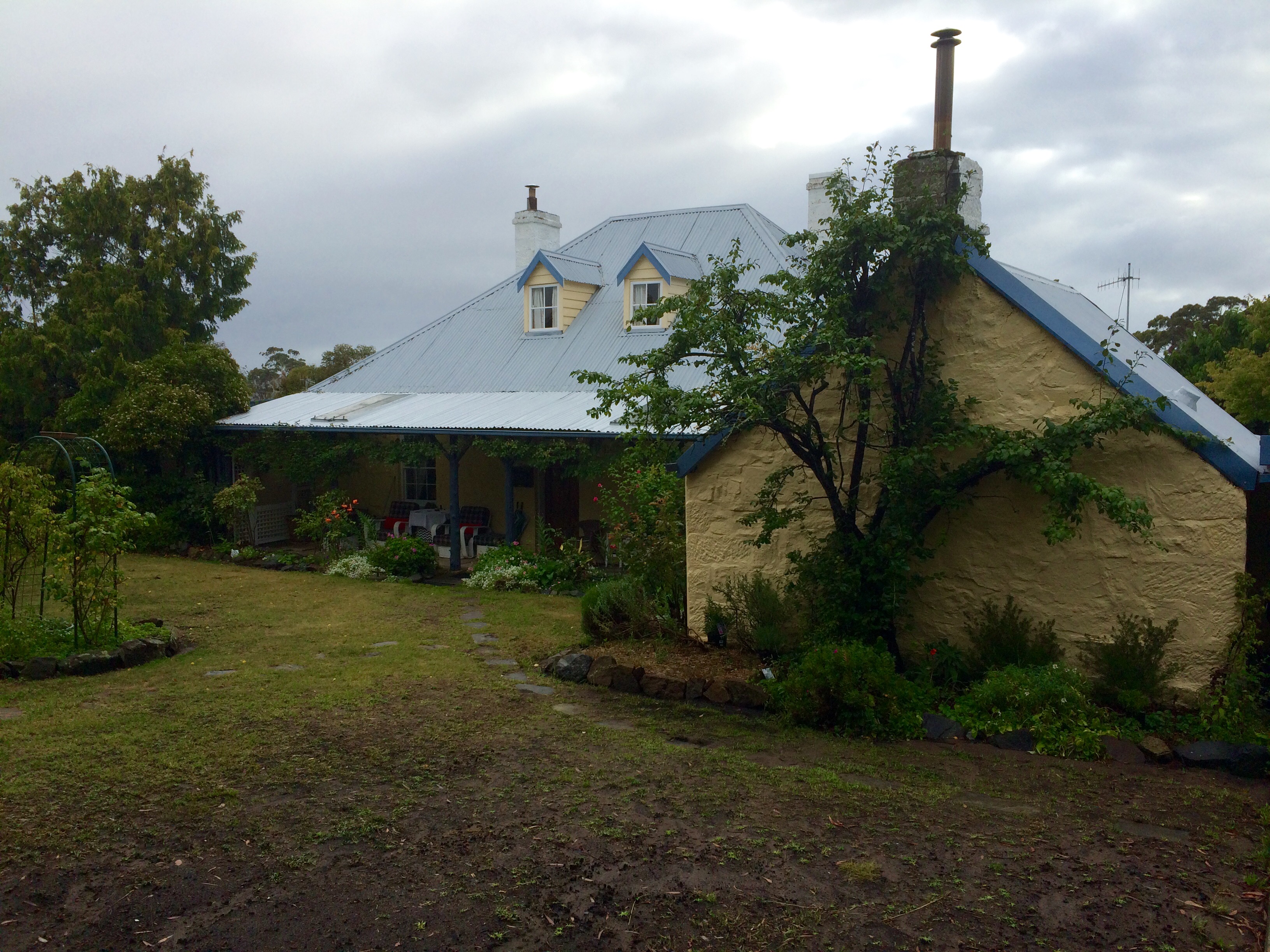
We arrived early in this small coastal town where we were staying in an older B&B called Sanda. We were delighted to find ourselves in a large home originally built in 1840 – like most larger homes from that era it was most likely built by convicts. Our quarters had stone interior walls and uneven stone floors. Two of the walls had been whitewashed at some point. There was a huge hearth in the center facing wall. Everything in the room was fittingly aged, including the lumpy little bed where I was sleeping. Barry and I were taking turns with who gets the larger bed. Most of our accommodations would have one queen sized and a small children’s bed. It was my turn for the little bed. That night I would find myself constantly sliding into a deep hollow on one side of the mattress.

The yard had large shade trees and a variety of fruit trees including a mulberry tree. Most of the trees and decorative shrubs and flowers in people’s yards are not native. There was a stunningly beautiful tree in the front yard which the proprietor called a Liquid Amber. The tree was perfectly shaped, full, and had leaves an eye catchingly bright shade of green. She tells me that they become yellow in the fall, then brown and fall off. It seems that in this climate most of the trees and foliage retain their leaves. The average winter day here is 10 – 15 degrees Centigrade. Pretty mild.

She also had a vegetable garden in the back and a chicken coop. We enjoyed a wonderful breakfast at Sanda with a variety of homemade jams from the orchard and really tasty homemade bread.

One of the other guests at the B&B was a retired forester. I learned from him that the huge trees we saw in old photos at Scottsdale were a variety of Eucalyptus and that there still were a few of those monsters around.

We have been seeing quite a few flocks of parrots and, with all the rain, the sound of frogs fills the air in lower stretches along the road. The parrots are a nuisance in the fruit orchards – netting is used in many places.

Sent from my iPad

Eaglehawk Neck

image

image

imageJan 31

We woke up to strong winds and rain. The rain was not that heavy but it had Barry pacing between the bedroom window, the view from the dining area, and the back door. Then he would let out a volley of what I would refer to as Australian. He does not like rain. The rain had let up by the time we left and the wind would be at our backs during the first half of our day. We couldn’t take the straight gravel road we had planned on due to washouts so we were on the roundabout highway route. It would add about 25k to our day. It was a long hard day. We had a strong headwind and lashing rain the last 50Ks with a total of 1511 meters of climbing for the day. We biked a total of 104Ks.

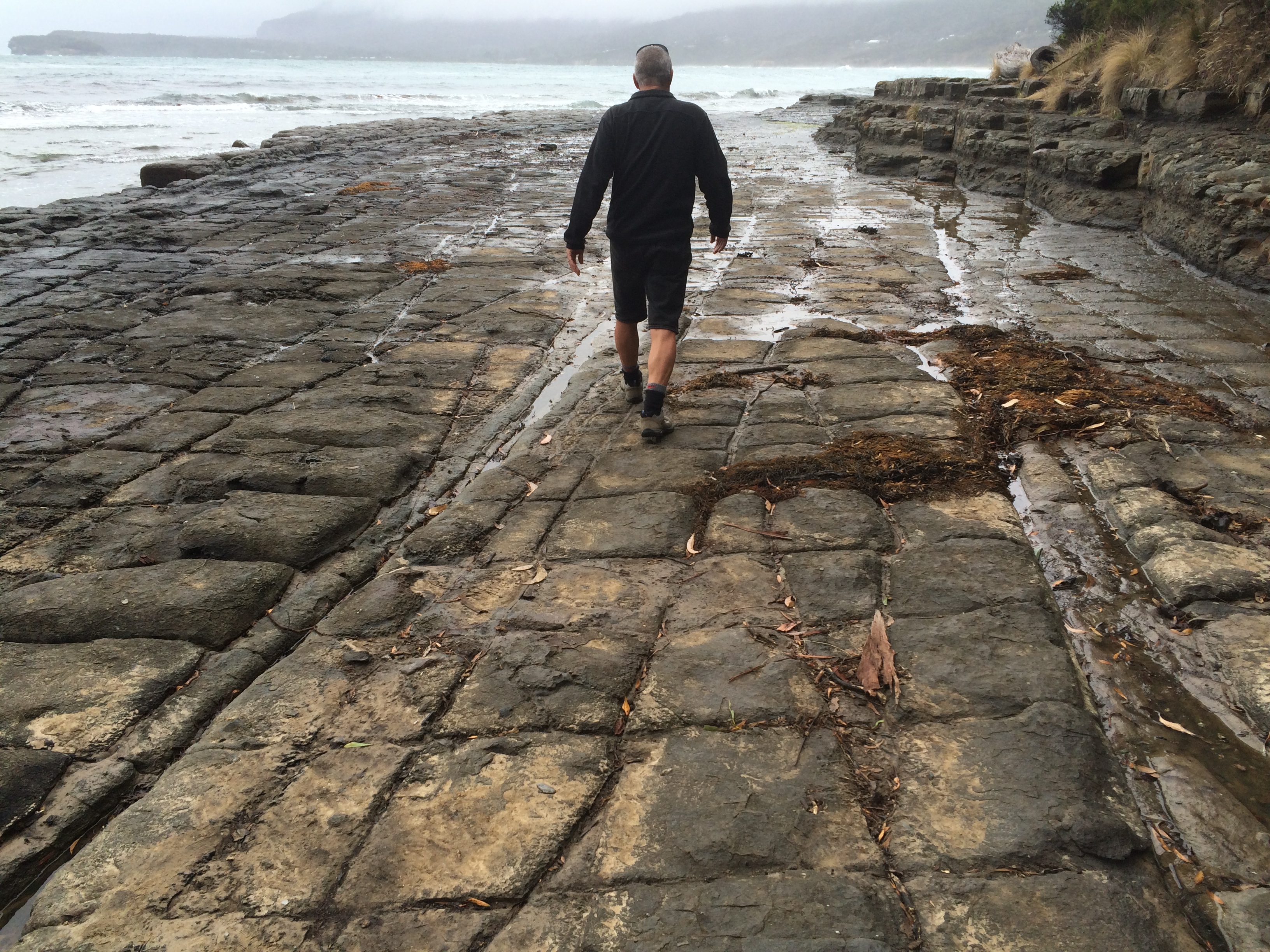
The view of the sea as we were coming into Eaglehawk Neck was fabulous. The craggy rocky coastline below was rimmed on one end by a white sand beach and all edged by heavy forest. It almost made us forget our weary bones. The “Neck” is a narrow small isthmus with the sea on either side. We checked in to the only hotel here – we are not in a town – and headed down to the beach on which the rock had formed as what is referred to as tessalated pavement. The beach looked like a road surface which had been paved with large rectangular stones. It was pretty remarkable. I’ll try to get a photo on this site tomorrow.

We are heading to Barry’s sisters at White Beach tomorrow.

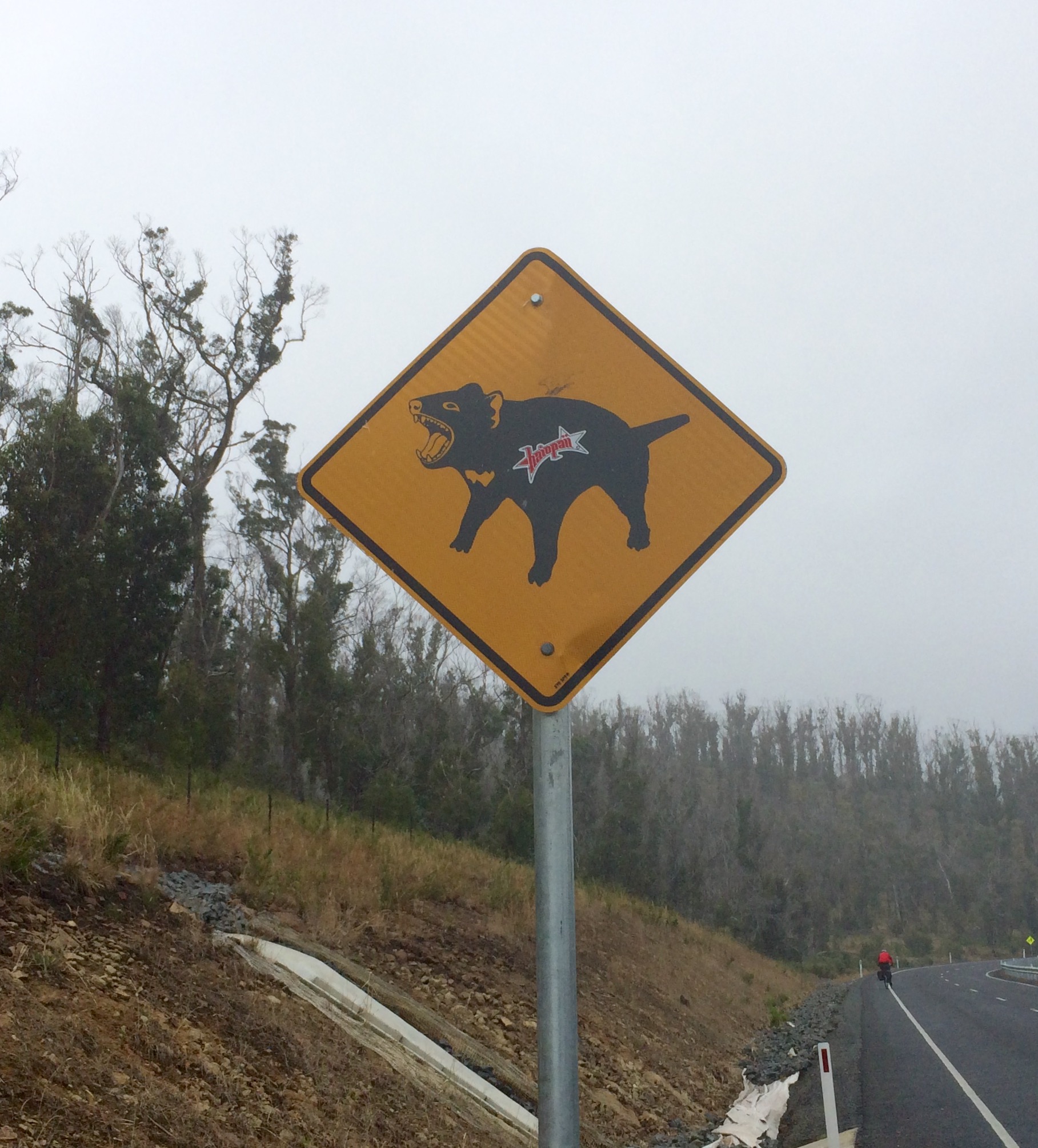
Photos – 1840 home – Tasmanian Devil road sign – tessalated pavement at beach

Sent from my iPad

Wineglass Bay

Jan 29

Last night the rain came in sheets – in waves as it rumbled on the metal roofed carport. Great weather for sleeping and I took advantage with eight solid hours. We waited for a lull in the wet stuff to head down to the coffee shop to catch up on our emails. I cleaned my chain and re-lubed. We headed down in a slow drizzle. After getting caught up on the Internet, we heard from a local that last nights rain was a record here and that the roads were washed out in both directions.

After lunch the rain stopped but still looked very threatening. I decided screw it I’m heading to Wineglass Bay. Barry elected to stay home – he doesn’t like to get wet. Off I pedaled the 6K into the Park and to the end of the road. The trail started off sandy then became very rocky as I moved up the saddle between mountains to the viewpoint at the crest of the heavily wooded slope. I stopped to take a couple of photos of this beautiful white sanded beach below but the mist and poor light made for poor shots. Down the other side to the beach I headed. The trail looked more like a creek bed with all the rainwater running down it. I met several other people including a group of six from Chicago. As I approached the beach I could hear the roar of the surf. Walking out of the woods onto the white sand I was greeted by a wide long semicircle beach being pounded by some very impressive waves. It was beautiful – and only four other people playing in the surf about a hundred yards away. They had camped there the previous night. I spent some time savoring the sights, the warm ocean air and the water rushing across my feet. A great Tassie beach and not a drop of rain the whole afternoon. Wineglass Bay got its name in the early whaling days when the blood of the butchered whales filled this wine glassed shape beach.

We’ve heard tonight that the road south is now re-opened so barring another big gulley washer tonight, we can bike again in the morning.

Sent from my iPad

Big Rains

Jan 28

We woke up this morning to hard rain. With 119k to bike down to Coles Bay today, we had been hoping that somehow the forecast for the whole East Coast of Tassie would miss us. Barry, especially, does not like rain. Living in Wallongong, south of Sydney, he is not used to inclement weather. He has his phone out and is busy researching the possibility of taking a bus and putting our bikes in the compartment below. I have much more experience with this wet stuff and don’t really mind it. My good friend John Wood used to call me to go running in the pouring rain – off we’d go. You can only get so wet and then it’s fine. That is, of course, as long as it is not cold outside. The temps here today will be in the 60’s and 70’s. We dawdled at breakfast. The rain would let up and then start again. Barry hasn’t had a call back from the bus company. It’s time to go. We loaded our stuff on the bikes under the cover of the hotel carport. Off we peddled into the rain.

Today we traveled along the seacoast the entire day on a paved road very similar to the narrower parts of scenic Highway 61 along Lake Superior where I live. We passed numerous sand beaches, rocky outcroppings, islands and hidden coves. The waves were crashing hard and large against the shore, prompting Barry to wish he had his surf board along. There were no big climbs today but the road weaved and bobbed along comfortably. Despite the rain, it was a great place to be on a bike.

There are very few people here in Tassie. It is high summer season yet no crowds and lots of space. Tassie is like one big small town. As I passed a guy working in his yard during a lull in the rain, he looked up and gave me a comfortable easy smile like he’d known me forever. “G’day, mate” with a wave as I cruised past. That’s the people in Tassie.

We have now moved into the Freycinet Peninsula. It is a National Park with small abruptly rising heavily wooded mountains and white sand beaches. The small village of Coles Bay fronts one of these beaches. A few fishing boats bob on their moorings and a small water taxi sits alongside the dock. This is where we will spend our day off tomorrow. Cole’s Bay.

Just a kilometer bike ride and a half hour hike away lies Wine Glass Bay. It is considered to be one of the ten most beautiful beaches in the world. You can also get there on the little water taxi located just below our accommodations. This white sand beach is shaped perfectly like the bottom of a wine glass and in the whaling days the blood of the butchered animals would color the water red leading to its name. We are hoping the weather will allow us to spend some time there tomorrow.

Sent from my iPad

To the Coast

Jan 26

Today’s ride to Scottsdale was described to us as a big climbing day despite its relatively short distance of 67k. The weather was good and we elected to travel on a smaller road that took us through Lilydale at our half way point. We find ourselves in mixed agriculture and forest. The trees are impressive size and though we are no longer in rainforest and it is the dry time of year here, it is still very lush. Our route saved us some of the steeper climbing over a pass that the main highway follows but there is still a considerable difficulty to our day. I find my right knee a little stiff today. The geometry on the cyclocross bike I took on this trip is less designed for big climbs than the mountain bike I used on my South American trip. I know that it will be fine but it is a notice to be sure to shift down and not to just power through today. We started our day biking at 8 and were very happy to be done at noon – the ride was not nearly as taxing for us as had been described by other cyclists we had met.

Scottsdale was a big timber town in it’s early days. The Pub where we had dinner that evening had a display of old photos of the early logging that were just amazing. Huge trees. One tree to a logging truck. Men with crosscut saws and wedges were dwarfed by the trees the were working at falling. I wish I had remembered to bring my phone to dinner so I could have photographed some of these images. We saw quite a few logging trucks during the day but of course they no longer carried the trees of yesteryear.

Our lodgings, Anabel’s, was opened in 1890 and was listed in the National Trust. The gardens and surrounding shade trees created a beautiful and comfortable setting. There had still been some smoke in the air from the fires but now the breeze cleared the air. Rain is predicted for the next few days but we are ever optimistic.

Jan 27

Our trip to St. Helen’s is 107k and is our last big day of climbing on this trip. We got an early start to try to get as far along as possible before the rains find us. We had learned about a trail along an old railway bed that would take us the first 26k and avoid some of the first steep climbs from some nice folks at the local info place. The rails never have too steep an elevation since the trains have to move on less aggressive climbs. It was a great choice since this trail went through some beautiful forest with huge ferns, thick trees and nicely packed rail bed. I had four wallabies cross in front of me on different times on this narrow trail including one just a few feet away from my tire. We got a few photos on this stretch and enjoyed the change of pace.

The grades on our remaining route were held to 6 percent so our legs appreciated that although our total climbing of 1550 meters was still a lot. The rain and wind found us around the halfway point but temps were OK so we persevered. The view of St. Helen’s on the water below us was a welcome sight. We shoved all of our wet clothing into the dryer and found a comfortable bar/restaurant.

Sent from my iPad

Day off in Launceston

Jan 25

Barry and I enjoyed a day off from the cycles today but were quite busy anyway. We started off with a hike up the beautiful gorge on the Tamar River. It is the most widely known attraction in this clean pleasant little city. There is a chair lift you can ride but we chose to walk the trail adjacent to the gorge. It wound its way up, down and around the bends while moving through the deep chasm with its rugged rocky sides. It is a dry time of year so the trees growing through opportunities in the rock were largely brown and blended into the surrounds. There were several park areas we hiked through. In one of these greener areas I saw my first live wallaby. A second one came over to check us out as well. Photo time.

At the head of the river was a small lake (the river was dry above this) and a small covered bandstand was tucked into a cluster of large shade trees. A beautiful spot. I walked in and discovered that it had been built in 1896 with funds donated by a local women’s group for Sunday concerts. All other activities were halted during these concerts including chaining up the children’s swings and “no playing games.” We were surprised to find peacocks wandering through the gardens. I took a photo of one of these gaudy birds on top of the roof. They were brought in when the gardens and bandstand were built and still reside here.

We wandered through the marina area as we worked our way back to our current home then spotting the National Automobile Museum of Tasmania. They had a 1953 Holden Station Wagon displayed outside and the promise of much more inside. It was a stunningly beautifully restored machine. So Barry and I reached into our pockets for the $12 entry fee. What a hoot it was to see all the old classic cars built all over the world. My favorite was the 1936 Jaguar roadster – two toned black and a deep violet. I didn’t even want to ask how much it would sell for. I had asked about the Holden and they said about $30K. The Jag would be out of sight. Aston Martins, Rolls Royces, old race cars, and so much more. Probably around 50 cars all refinished perfectly, they are all privately owned and are rotated regularly to make room for others. The oldest was an 1899 Locomobile built in the US. We enjoyed our time in this great collection.

We headed on up a block for a tour of the James Boag Brewery. Cascade in Hobart and this brewery here are the largest and most popular breweries in Tasmania. It was fun to hear about the process and the ingredients. We had a little sampling of beer and cheese then headed on back to actually have a little rest.

Tomorrow we head up into the mountains of the Northeast then on to the beaches of the Eastern coast.

Sent from my iPad